
The Positivity IQ Measurement

"You can't manage what you can't measure". "If you can't measure it, you can't improve it."
I fully accepted the advice to be "more positive". But I could not take it on faith without some way to know if I was becoming more positive.
If I knew what I was thinking, I might be able to manage my self-talk.
We are experts at creating and believing negative thoughts.
But we usually have trouble creating, believing, and sustaining positive thoughts.
The goal of practical Positivity IQ is to learn to manage the positive, negative, and uncertainty/doubt so that the negatives do not overwhelm your positive aspirations and efforts.
My background is primarily in quantitative research. But I've always recognized there are many things we can't readily measure, but that still might be real and important.
The Positivity IQ is based on my experience and professional work over thousands of research studies. I combined the principles of general IQ, multiple personalities, positive psychology, and standard statistics.
Yet, I don't believe the general advice just to be "more positive" is adequate to support effective Positivity.
If your self-talk is positive only 5% of the time and negative 95%, increasing positive thinking to 20% may not be strong enough to overcome inevitable fears, uncertainty and challenges.
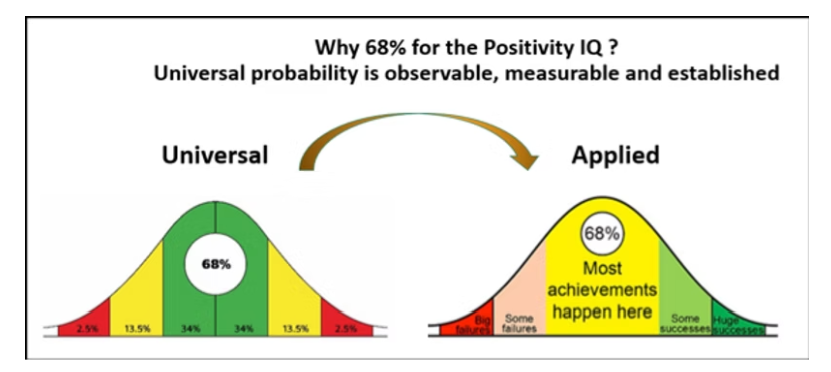
The goal for effective Positivity is to be positive "most of the time.
And "most" is already established and recognized in our statistical rules.
The advice is to have positive thoughts "most of the time." Most of the time is 68%.
I want to reach the point where my confidence and persistence enable me to keep working toward my goals.
Being average is good!
You can't change the nature of the universal statistical curve. But you can improve your Positivity IQ to enable a higher probability of success.
More good news!
You don't have to be positive 100% of the time, and a modest level of negativity and doubt is inevitable and necessary.Humans have a natural negativity bias, which is our survival mechanism.
But we have not been taught how to manage our natural Positivity for increasing the probability of achieving our goals.
The Positivity IQ target is 68% – a realistic goal that accommodates inevitable and unstoppable negative thoughts we all have — but still provides strong support to pursue your goals with confidence.
"You've Always Had the Power, My Dear; You Just Had to Learn It for Yourself."
Glinda from The Wizard of Oz to Dorothy.